
Victron 3 phase ESS – Part 2: Choosing the batteries
In part 1 we laid out the plan for a 3-phase Victron ESS in a shed next to our house in Flanders, Belgium. One big question was still open at the end of that article, because we had not yet picked the battery packs. That decision has now been made, so in this part we explain how we chose and why we ordered the EEL V6 Pro.
Table of Contents
What the battery had to do
Before comparing brands, we wrote down four requirements. The battery has to be a 48 V (16S) LiFePO4 system with about 32 kWh in total, so it matches the three MultiPlus-II units from part 1. It also has to fit the Lynx DC design, in which every pack gets its own cables and Class T fuse. Because we have to lift and mount everything ourselves in the shed, each pack must stay light enough to handle safely. Most importantly, the battery has to be safe and come with the documentation an AREI inspector expects, since a home battery of this size cannot go live in Belgium without passing that inspection.
The options we weighed
We ended up with four realistic routes, and each one scored differently on price, effort and inspection risk.
| Option | Price per kWh | Build effort | AREI inspection risk |
|---|---|---|---|
| DIY kit (box plus loose cells) | Lowest | High | High, because the finished pack has no product certification |
| Branded ready-made battery | Highest | Low | Low |
| All-in-one 32 kWh cabinet (EEL MB56) | Medium | Low | Low, although far too heavy for our shed |
| EEL V6 Pro | Medium | Low | Low, provided the paperwork is complete |
The DIY route was tempting, because kits from EEL, Seplos or Yixiang give you the most capacity for your money. However, a pack you assemble yourself is legally a product you built, which means you also carry the burden of proving that it is safe. Branded ready-made batteries solve that problem, although they cost noticeably more and often limit how you can expand later.
Why we picked the EEL V6 Pro
The EEL V6 Pro sits right in the sweet spot between those extremes. Its price per kWh stays well below that of most branded batteries, while EEL was able to offer all the certifications we asked for. Inside are 16 EVE LiFePO4 cells, a cell brand that is widely used in home storage, so two packs give us the roughly 32 kWh we planned in part 1.
The split into two separate packs also suits our shed far better than a single heavy cabinet, because two people can still lift each pack. We also ordered EEL’s 48V 16S server rack unit pallet with four wheels, so the packs stand on a mobile cart that we can simply roll aside for maintenance. Every pack still lands on its own Class T fuse in the Lynx Class-T Power In, exactly as the DC design requires.
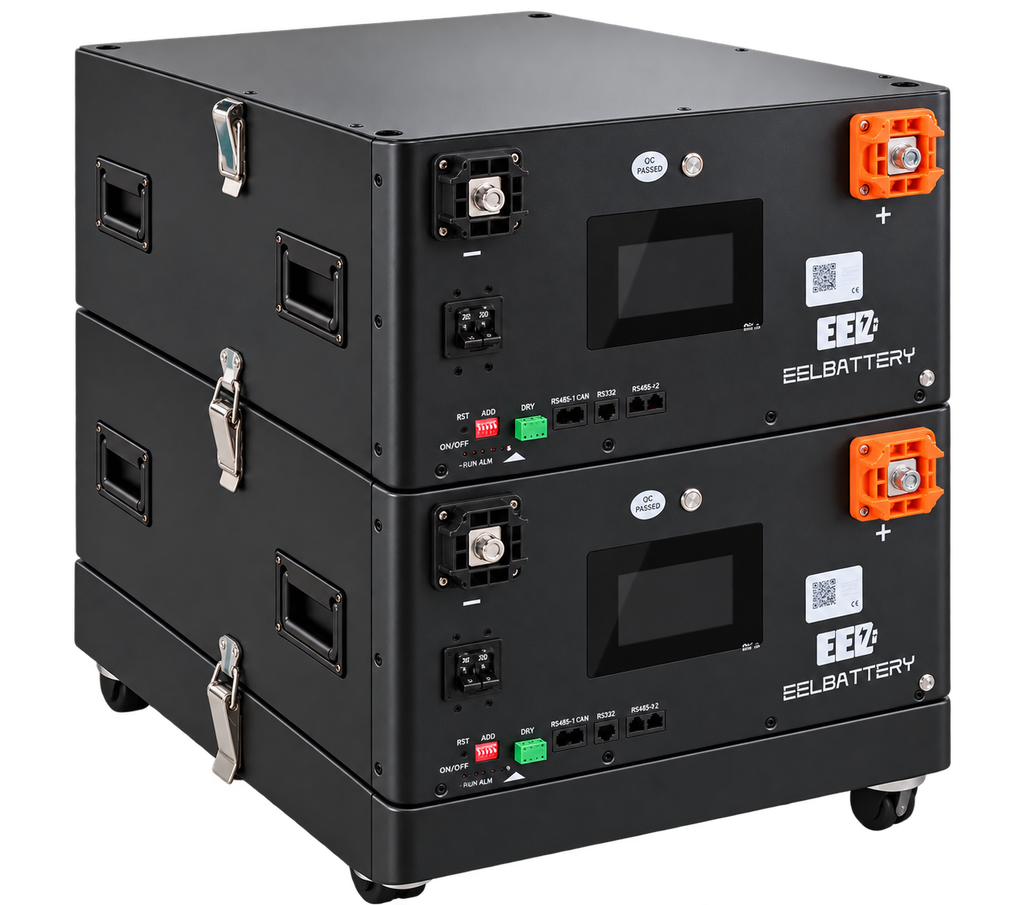
The paperwork was the deciding factor. EEL could supply all the documents we need, including an EU declaration of conformity under the Battery Regulation (EU) 2023/1542 and the IEC 62619 test report, because those are what an inspector wants to see for a stationary lithium battery. A battery that performs well but cannot prove its safety is simply no option for an installation that has to pass the AREI inspection.
What’s next
We have only just placed the order, so it will take some time before the packs arrive in Belgium. As soon as they do, we will unbox them, check the cells and the documentation, and set them up in the shed (on camera, for a later video). Part 3 covers the changes we had to make to out house-distrubution panel, the transfer switch (for maintenance) and the shed’s AC side.
Your turn!
Would you have picked the EEL V6 Pro as well, or do you swear by another brand? Let us know in the comments, and subscribe to our YouTube channel so you don’t miss the unboxing.
Please subscribe to our newsletter!