

Table of Contents
Why a home battery belongs in the shed
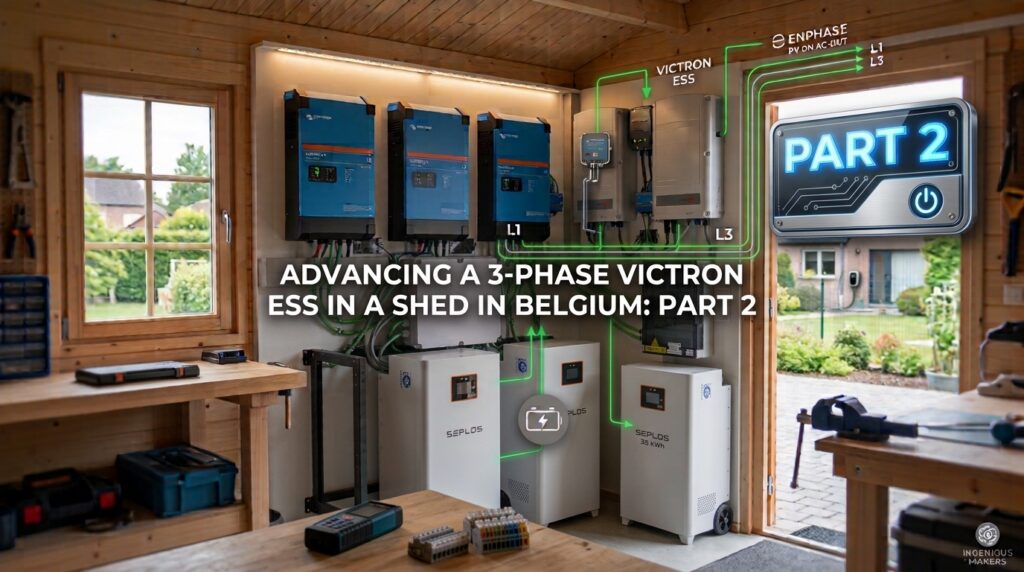
A 32 kWh Victron ESS home battery can keep a Belgian house running through a grid outage, but only if the build passes the strict AREI inspection, which is mandatory for a home battery of this size in Belgium. This is the first part of a series about the 3-phase Victron ESS we are planning in a shed next to our house in Flanders, Belgium. In this article we walk through the design and the safety choices behind it, and upcoming articles and YouTube videos will follow the actual build step by step.
The shed made sense for three reasons. It keeps lithium batteries out of the living space, it offers plenty of wall room for the Lynx DC system, and it is only 27 metres from the main meter cabinet. That short cable run is the easy part, whereas making everything safe on a TT grid is the real puzzle.
The 3-phase Victron ESS at a glance
The heart of the planned system is three Victron MultiPlus-II 48/5000 inverter/chargers, one per phase, for 15 kVA of backup power. They draw from two 16S LiFePO4 battery packs with 32 kWh of storage, and a VM-3P75CT meter at the grid connection steers the battery towards zero export.
In normal operation the grid feeds the house through the shed ESS. When the grid fails, the MultiPlus-II units take over and the Enphase panels and the shed roof panels on the MPPT keep charging the battery, while the dashed Sontheimer bypass lets you skip the ESS for maintenance.
AC coupling Enphase with Victron: the Factor 1.0 rule
Our roof already carried 18 Enphase IQ7+ microinverters at 295 VA each, which adds up to 5.31 kVA. Instead of replacing them, we will AC couple them to the AC-out of the MultiPlus-II units, so the panels keep working during a blackout.
Victron sets one firm limit for this, known as the Factor 1.0 rule. The total PV inverter power on AC-out may never exceed the combined power of the Victron inverters. Our check is simple:
| Item | Value |
|---|---|
| Enphase on AC-out | 18 × 295 VA = 5.31 kVA |
| Victron capacity | 3 × 5,000 VA = 15 kVA |
| Ratio | 0.35, well below 1.0 |
In island mode the MultiPlus-II raises its AC frequency when the battery is full. The Enphase units see that shift and throttle down on their own, so the battery is never overcharged. One more tip from the Enphase technical brief: never route a battery circuit through an Enphase CT, because the gateway will then misread your consumption.
Safety on a TT grid: earthing, RCDs and the ground relay
In Belgium most homes sit on a TT grid, which means your own earth electrode carries any fault current. That makes residual current devices (RCDs) the backbone of your safety, and the Belgian AREI code is very precise about them.
One earth, not two. It is tempting to drive a second earth rod at the shed, but the AREI allows only one earthing installation with one disconnector per installation. The shed therefore shares the house earth through the continuous 10 mm² protective conductor inside the 5G10 supply cable, and it gets a local main equipotential bar. Because the run is only 27 metres of 10 mm² copper, the fault loop stays short and predictable. Aim for an earth resistance well under 100 Ω, because that is the limit for a single dwelling.
RCDs that cooperate. Two 300 mA RCDs end up in series between the grid and the house circuits. They only coordinate through time, so the upstream one must be a selective (S type) model and the downstream one instantaneous. Every final circuit then sits behind a 30 mA type A RCD with at most eight circuits each.
What happens in a blackout. When the grid fails, the MultiPlus-II opens its backfeed relay and closes its internal ground relay. That relay bonds neutral to earth on the AC-out side, so the island network gets a fresh neutral reference and your RCDs keep tripping as they should. A four-pole Sontheimer transfer switch lets you bypass the whole ESS for maintenance.
The DC side: Lynx distribution done right
A 48 V LiFePO4 bank can deliver a huge short circuit current, so the DC side needs as much care as the AC side. We plan to build it entirely on the M10 Lynx range, because every fuse and cable then sits on one tidy busbar.
Each pack gets its own Class T fuse, since only that fuse type safely breaks a lithium short circuit. The Lynx Smart BMS 500 adds a contactor, so one emergency stop button can disconnect the whole DC bus. Running it with third-party packs is not officially supported by Victron, which is why the built-in BMS of each pack remains the cell protection and talks to the system over CAN.
DIY or ready-made: the battery choice is still open
We have not yet chosen the battery packs themselves. DIY kits from EEL, Seplos or Yixiang currently give you the most capacity for your money, although they pose a real risk at the AREI inspection, because a self-assembled pack comes without the product certification and documentation that the inspector expects to see. A certified ready-made battery makes the inspection far more predictable, although it comes with its own drawbacks and challenges, such as a higher price per kWh, the need for proven compatibility with the Victron system and less freedom to expand later. Because neither option is clearly better, the choice is even harder than we expected, so we will weigh both in a later part of this series.
What’s next in this series
This first part covered the plan on paper, although the real work still has to start in the shed. Because every design choice has to prove itself during the AREI inspection, we will document the whole build in a series of articles and YouTube videos.
In the upcoming parts we will install and wire the distribution boards in the house, mount the Lynx DC system and the battery packs in the shed, and commission the three MultiPlus-II units in VEConfigure. After that we will connect the Enphase system on AC-out and pull the grid to test island mode, while the final part takes you through the AREI inspection itself.
Your turn!
Would you go for a budget-friendly DIY battery kit, or would you play it safe with a certified ready-made pack? Tell us in the comments below, because the best tips and warnings may well end up in part 2.
Please subscribe to our newsletter!
Why would you not just buy stackable batteries like Pylontech or Dyness? Those come with all the proper certifications so you can save yourself the hassle.
Well, we can safely assume all those batteries come from China as well, and that is not a bad thing. China rules the battery market at this time, so whether a battery is good or bad is determined by the manufacturer rather than where it comes from.
Personally, I want a reliable battery that comes with the appropriate paperwork so I can pass the AREI inspection without issues.
I am in contact with a few suppliers, and some of them were able to produce the correct certificates and test reports.
I am close to deciding what I’m going to order, but I can tell you for sure it won’t be Pylontech.
I can see your point 😛 Didn’t know there where that manny issues. Good luck with your project, I’ll keep following.
What batteries are on your shortlist?
I evaluated several options, including the Yixiang DIY V3 BOX, EEL V6 Pro (Max), Seplos Mason 314L-O, Felicity FLB48314TG1-H, and the Dyness Powerbrick Plus (16.07 kWh).
Today I decided to order two EEL V6 Pro boxes equipped with EVE MB31 double-thread terminal cells and the integrated heating option. EEL offered the best overall deal, complete with CE certification and full test reports.
Now, it’s just a matter of waiting to see if everything arrives in good condition and as agreed.
Awesome project. If you do this with the same enthusiasm and precision as your other projects, it will definitely go well! Where is the follow button?
Thanks! I’m afraid there is no follow button for future blog articles 😉
What you could do is subscribe. We do not send any spam, just updates for new blog articles.
quick q: since the shed uses the same earth via the 5G10 over 27 m, did you run fault-loop/trip-time calc for the 300 mA upstream selective vs the downstream instant RCD? any extra discrimination tweaks planned?
We didn’t put detailed fault-loop maths in this part. The plan is to aim for earth R well under 100 Ω. RCD coordination is by time: upstream is a 300 mA S-type (selective) and the downstream a 300 mA instantaneous, with every final circuit behind 30 mA type A RCDs. Also note the MultiPlus-II opens its backfeed relay and closes its internal ground relay in island, so the island retains an N-to-E reference and RCDs keep working. We’ll cover commissioning and any measurements in later parts.
nice write-up. love the shed decision. keeping the LiFePO4 out of the living space and the Lynx DC layout with Class T fuses looks really tidy and safe. keen to see the wiring vids and the AREI outcome.
thanks, appreciated
Thanks!